
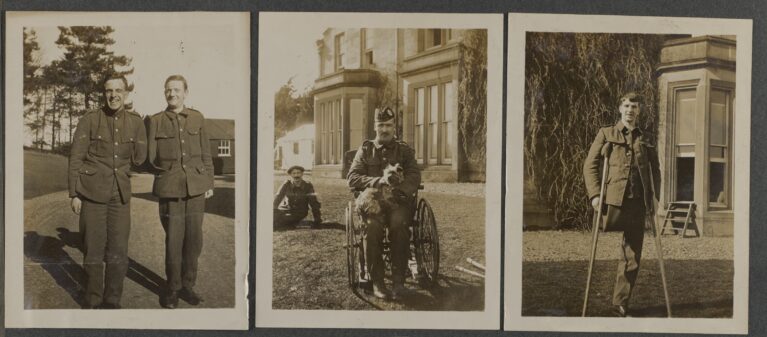
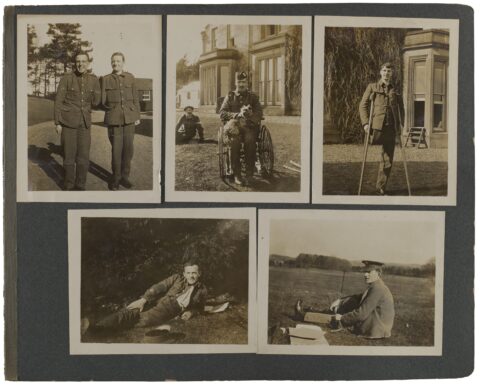
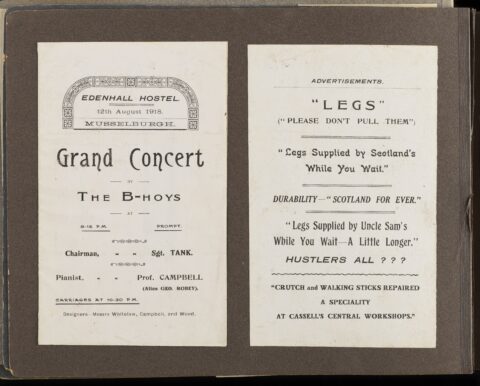
Edenhall Hospital for Limbless Sailors and Soldiers was opened in Kelso in 1915. Run by the Red Cross, the hospital moved to Musselburgh in 1918 after its committee acquired Pinkieburn House, once the ancestral home of the Lindsay family. The hospital offered convalescence and rehabilitation to amputees, and former patients even made artificial legs in the joinery workshop. This photograph album, spanning Edenhall’s time in both Kelso and Musselburgh, is one of the few original artefacts to survive from this period of the hospital’s life. It provides an invaluable glimpse into the day-to-day life of patients and the technologies that were available to them.
The Artificial Limb

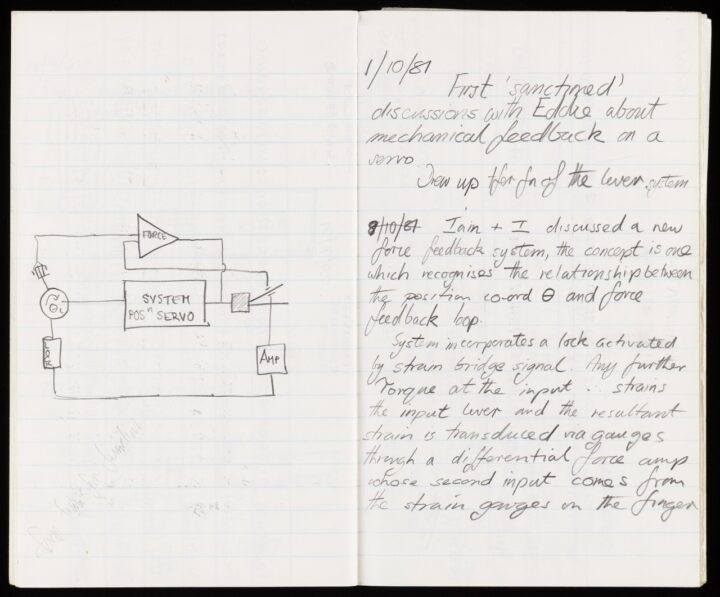
University of Edinburgh graduate David Gow joined the Bioengineering Centre at the Princess Margaret Rose Hospital in 1981 as a Research Associate. Working both inside and outside the NHS, he went on to develop a number of pioneering hand and arm protheses for both adults and children. LHSA holds notes charting the development of Gow’s thought and practice, beginning with a diary starting on his very first day at the Bioengineering Centre. By 1996, he was developing what would become PRODIGITS, an experimental partial hand system that could be fitted to children as young as four. Inspired by the mechanism in his wife’s exercise bike, individual motors fitted inside each finger, meaning that the hand could be scaled down to a greater extent than had been possible previously.
|
||
| Object reference | LHB71/2/4/1 (LHSA) |
|---|
Please note this description originally formed part of a physical exhibition and references the display arrangement.
|
||||
| Object reference | LHB71/2/1/1 (LHSA) |
|---|
Please note this description originally formed part of a physical exhibition and references the display arrangement.
Please note this description originally formed part of a physical exhibition and references the display arrangement.

Since 1988, Gow’s team at the Bioengineering Centre had been working to develop a world first: an electronically powered arm with parts that could be put together in different ways. The Edinburgh Modular Arm System (EMAS) was launched ten years later. It was developed with the help of Moffat hotelier R. Campbell Aird, who lost his shoulder and arm through cancer. Not only was Aird the arm’s first user and international public face, but he also sent feedback on EMAS to the engineering team and co-produced research papers with Gow. Controlled by electrical signals from muscles, the ‘bionic arm’ had a powered elbow, wrist and fingers. It was lighter and more sensitive than earlier prosthetics, weighing less than a human arm. Gow went on to invent the i-limb in 2007, a revolutionary prosthetic with rotating thumb and articulated fingers, each with an individual motor powered by pulses in the brain.
|
||
| Object reference | LHB71 (LHSA) |
|---|
Please note this description originally formed part of a physical exhibition and references the display arrangement.
|
||
| Object reference | LHB71 (LHSA) |
|---|
Please note this description originally formed part of a physical exhibition and references the display arrangement.

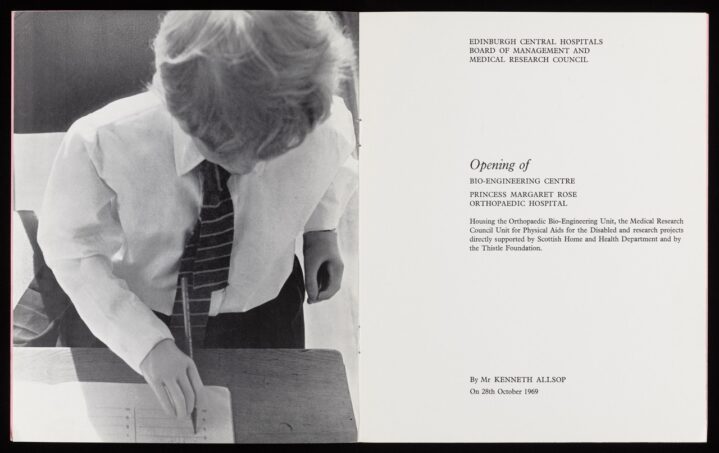
In 1963, Edinburgh began developing artificial limb technology with the opening of the Powered Prosthetics Unit in George Square. The unit focused on creating artificial arms for children born with disabilities as a result of thalidomide, a drug given to pregnant women in the 1950s for morning sickness. The work later moved to the Princess Margaret Rose Hospital, where efforts continued to help disabled children live more independently. Head Occupational Therapist Aline Macnaughtan published this booklet on clothing adaptations for children with prostheses. In 1969, a larger Bioengineering Centre opened at the hospital, developing externally-powered prosthetics and other assistive devices like feeding aids, as well as researching aids for the disabled with “the needs of the patient clearly in mind”.
|
||
| Object reference | LHB71 (LHSA) |
|---|
Please note this description originally formed part of a physical exhibition and references the display arrangement.